

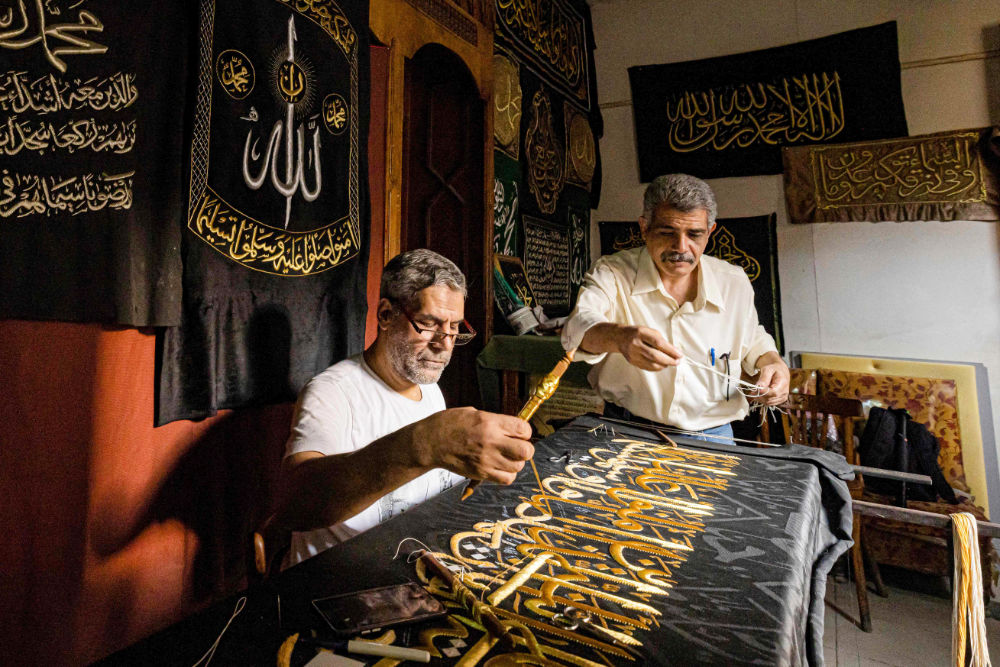
Under the steady hum of a ceiling fan, Ahmed Osman weaves golden threads into black fabric, creating verses of the Quran, a century after his grandfather's work adorned the Kaaba in the Grand Mosque of Makkah.
The ceremonial hanging of the kiswa, huge pieces of black silk embroidered with gold patterns, over the cube-shaped structure that is the centerpiece of the Grand Mosque, symbolizes the start of the annual hajj pilgrimage, which begins this week.

Osman's family was honored to produce the kiswa.
His family's creations will be sent in a camel caravan to Islam's holiest site in western Saudi Arabia, toward which Muslims around the world turn in prayer.
Now Osman maintains the tradition in a small workshop hidden above the tangled labyrinth of the Khan al-Khalili bazaar in central Cairo, where mass-produced souvenirs line the alleyways.
The area is historically home to Egypt's traditional crafts, but artisans face growing challenges.
Materials, mostly imported, have become expensive, especially amid Egypt's economic troubles and currency devaluation.
The sharp drop in purchasing power makes high-quality handmade goods unaffordable for the average Egyptian, while masters struggle to pass on their skills as young people move to more profitable work.
This would not have happened «if the craft brought in good money,» sighed Osman, bent over one of the many tapestries that fill his workshop.
Sheets of black and brown felt are covered with verses and prayers, intricately embroidered in silver and gold.
Each stitch echoes the «sacred ritual» that was entrusted to Osman's grandfather in 1924.
«Throughout the year, 10 craftsmen» worked on the kiswa covering the Kaaba, which pilgrims circumambulate, using silver thread in a lengthy labor of love.
Since the 13th century, Egyptian craftsmen produced the giant cloth in sections, which authorities delivered to Mecca with great ceremony.
Celebrations featured processions through cities, accompanied by guards and clerics at the sides, while Egyptians sprinkled rosewater from balconies above.
Osman's grandfather, Osman Abdelhamid, was the last to oversee the kiswa fully made in Egypt in 1926.
From 1927, production began moving to Mecca in the nascent Kingdom of Saudi Arabia, which fully took over kiswa production in 1962.
The family continued embroidering military insignia for Egyptian and foreign dignitaries, including former presidents Gamal Abdel Nasser and Anwar Sadat.
«In addition to our work with embroidering military ranks, my father began embroidering Quranic verses on tapestries,» and then reproduced entire sections of the kiswa.
Clients began flocking for «exact replicas of the kiswa, down to the smallest details.».
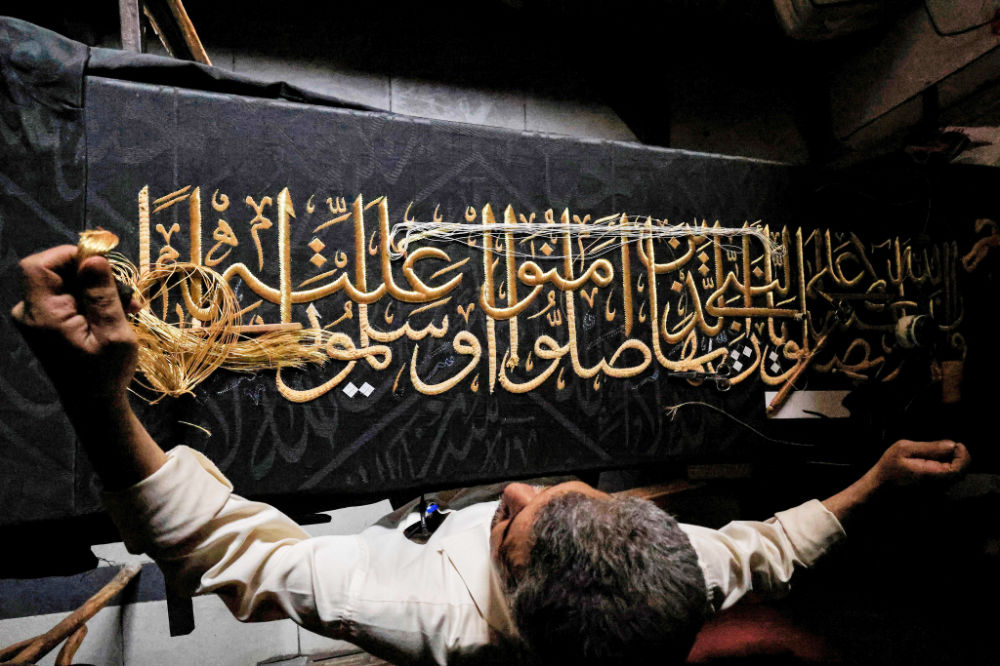
Although today they offer small paintings for as little as 100 Egyptian pounds (about $5), large custom orders cost several thousand dollars, such as replicas of the Kaaba doors, which Osman proudly claims are indistinguishable from the originals in Mecca.
But the family is not immune to the economic shocks that began with the coronavirus pandemic, which devastated small businesses and crafts in Egypt.
Since early 2020, they sell about «two pieces a month,» whereas they used to sell at least one tapestry a day.
Osman fears that a sense of «global austerity» makes a business recovery unlikely.
Today there may be only a dozen or so craftsmen whose work he considers authentic, and many artisans are abandoning the craft in favor of faster cash flow.
«They can earn 200 to 300 pounds a day» ($10-16), driving a tuk-tuk or a minibus, Osman said. «They are not going to sit at a loom all day and break their backs.».
But nevertheless, a century and a half after his great-grandfather left his native Turkey and brought the craft with him to Egypt, Osman says he has remained faithful to the methods he learned as a child, when he ran away from school to watch his father work.
«We must maintain the craft just as we learned it, so that it matches the heritage we inherited,» he said.