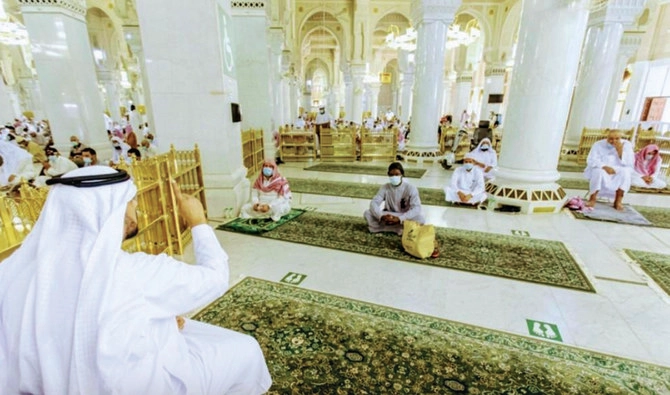
In line with the Kingdom's Vision 2030, the General Authority for the Care of People with Disabilities at the General Presidency for the Affairs of the Prophet's Mosque continues its work and efforts to serve people with disabilities at the mosque during Ramadan.
The directorate has allocated a special room in the mosque to serve people with disabilities, which can accommodate about 100 people. Staff trained in sign language interpret Friday sermons and lectures for people with hearing impairments.
During an interview with Arab News, Dr. Khalid bin Sulaiman Al-Tukair, a sign language interpreter at the Prophet's Mosque, stated that the General Presidency for the Affairs of the Two Holy Mosques was one of the first to interpret Friday sermons for a group of deaf people living in the Islamic world through a specialized room on the roof of the Prophet's Mosque.
Later, live broadcasting of the sessions was carried out on Channel 2 and the «Sunnah of the Prophet» channel.
«Nearly 20 million deaf Arab Muslims around the world benefit from the Friday sermon,» Al-Tukair said, adding that previously people with hearing impairments benefited only from the Friday prayer and did not benefit from the sermons of the Two Holy Mosques. .
He emphasized that the greatest achievement for an interpreter is how his interpretation affects people with hearing impairments.
«The interpreter manages to convey between 70 and 90 percent of the content to the deaf, most of whom are eager to attend the Friday prayer,» Al-Tukair said.
«The interpreter analyzes information and simplifies it… for the deaf in fractions of a second. Arabic has about 12 million words, while sign language does not exceed 20,000 words.».
He said that sign language interpreters are the ears of the deaf, and that the response of the Arab and Islamic world is impressive and remarkable. «Saudi signs are the core of the religious sign language in the world. One hundred and fifty deaf people from around the world usually meet in the last 10 days of Ramadan in a place allocated and equipped for them on the roof of the Prophet's Mosque on the southern side through Gate No. 5 to enjoy interpretation and knowledge.».
Arabic has about 12 million words, while sign language does not exceed 20,000 words.
The greatest achievement for an interpreter is that his interpretation affects people with hearing impairments.
Maram Al-Juwaid, a linguist specializing in sign language, told Arab News that «sign language is not just random hand movements, but a linguistic system consisting of symbols that represent words, concepts, or ideas of a language.
«This is done (by movement) of one or both hands to give meaning to things and people. Its unique linguistic characteristics are characterized by facial expressions, body parts, and linguistic signs such as hand shape, movement, place, and palm direction. It is a language linked to the environment, customs, and traditions surrounding it. Like spoken language, sign language varies from region to region and reflects the history, culture, and social norms of the deaf community.».
Al-Juwaid noted that Saudi sign language is an independent language, not a translation of spoken Arabic. «It has a special system that distinguishes it from spoken languages. Like other human languages, it has developed and flourished through the Saudi deaf community. It is (a) language with a rich vocabulary that is a main component of the deaf culture in the Kingdom, where deaf people have sought to pass it down from generation to generation so that it becomes the primary language in all educational, cultural, and social aspects of life.».
She added that Saudi Arabia has ensured the rights of persons with disabilities and provided them with all types of care and support in the Kingdom, including deaf and hard-of-hearing people.
«The Kingdom has attached (a) great importance to promoting the learning of Saudi sign language and developing the linguistic and cultural identity of the deaf. It has also provided humanitarian assistance to this precious segment of society, including Saudi sign language interpreters.».
Al-Juwaid emphasized the attention and care that the General Authority for the Affairs of the Two Holy Mosques gives to deaf and hard-of-hearing people.
«It (allocated) for them a special prayer room with a sign language interpreter to interpret speeches, lessons, and fatwas. It also provided them with special places where they can learn to memorize and recite the Holy Qur'an in Saudi sign language.
«Other services include navigational symbols in the Holy Mosque to guide them to various places and facilities inside the mosque through drawn and abbreviated symbols. The Fatwa robot is another major technological breakthrough in providing pilgrims with excellent service. It is most popular among pilgrims, as it gives them legitimate answers to questions about the rituals they perform and other religious questions,» Al-Juwaid explained.